Three elements characterize big data management: Volume, velocity, and variety.
Of the three, volume is becoming a greater concern for companies. The amount of data collected is only growing!
IT experts constantly have to adopt new terminology to describe the massiveness of data. It's no longer surprising to hear about petabytes, exabytes, or even zettabytes!
How to manage the abundant influx of data
This influx of data is flooding businesses. All these information resources are valuable for business, but how do we collect, organize, and store them? Data management is the solution to managing a colossal volume of data.
The real challenge of data management is to transform the raw material into useful information for the company - bearing in mind the "garbage in, garbage out" principle: Raw data is worthless and will only produce waste if it is not properly cleaned up before being used.
Data management to enhance the value of data
Data management does not stop at managing the volume of data entering the databases. It is also useful for managing the other two V's: Variety and velocity.
- Variety: with the multiplication of sources and formats, learning to know, prioritize, and control data flow has become necessary.
- Velocity: to fully understand the challenges of velocity, you need to understand the rate of change of the data, i.e. the frequency of creation of new data, the means to store it, the time to process it, and the target audience.
The three dimensions of data management are:
- Technical management
- Controlling the cost of data
- Pedagogy and team support
Be careful not to be satisfied with a posteriori management of incoming data or focus on only one department at a time. It is essential to federate all the technical and business players around a collaborative approach.
Why? If all the players contribute to the purification and enrichment of data knowledge, they can take full advantage of it. This is the principle of data management: Transforming data and making it usable by all through a joint effort.
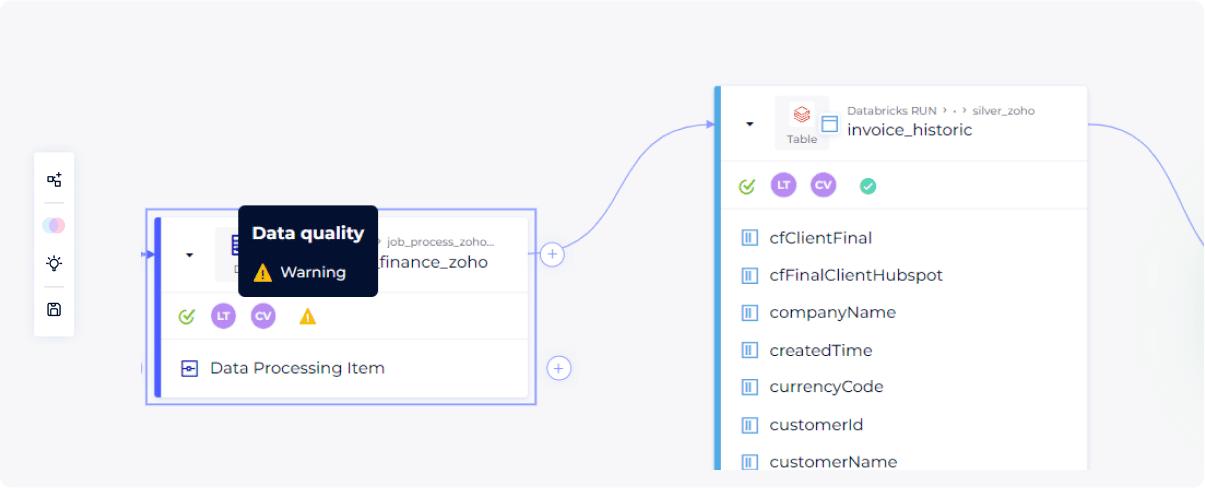
Data quality monitoring
Building success together on a strong foundation of high-quality data
At DataGalaxy, we champion data quality, emphasizing accuracy, reliability, and consistency. By pulling data health signals into DataGalaxy, we strengthen our commitment to data integrity and operational excellence, ensuring businesses make informed decisions with confidence.
To do this, you can use methods that have already proven their worth: collaborative data mapping, interactivity, and incrementality, as well as the use case approach.
Make data management sustainable
Beyond data knowledge, you have another challenge (and not the least important one) to take up: Making your company's data management sustainable. You must integrate it into everyone's daily practices!
Setting up data maps to make data management issues permanent is not enough: Business units must be regularly connected to a data catalog and update the information as soon as necessary.
All this requires good communication and successful change management: Make sure that the businesses understand the approach's benefits and take ownership of it!
The challenge of data management is to control the high volume of data coming in, but also to study the data to understand it well and to make better use of it. It's about setting up a system to manage the influx of data as well as possible, transforming it to make it accessible to everyone, and changing the very culture of the company.
Data governance for better data management
Data governance provides the framework for ensuring that data management practices are consistent, accountable, and aligned with business objectives.
It establishes clear roles and responsibilities for data ownership, defines data quality standards, and outlines policies for data access, security, and compliance.
This structured approach guarantees that data is not only managed but also trusted.
With effective data governance, businesses can create a single source of truth, minimizing redundancies and contradictions across departments. This becomes especially important as the volume and complexity of data increase, enabling organizations to scale their data strategies without sacrificing accuracy or regulatory compliance.
From policy to practice: Enabling a data-driven culture
Successful data governance is not just a matter of documentation or compliance: It must be embedded in the organization’s culture. This means equipping teams with the right tools, training, and incentives to follow governance protocols consistently.
A well-governed data environment empowers employees to make decisions based on high-quality, well-documented, and accessible data.
It encourages cross-functional collaboration and transparency, turning data governance into a strategic asset rather than a bureaucratic constraint.
Ultimately, integrating governance into everyday operations helps create a sustainable data ecosystem where insights are derived faster, risks are mitigated proactively, and innovation thrives on a foundation of reliable information.
Fueling smarter decisions for
200+ industry powerhouses.