A common query in big data management is differentiating between a data owner and a data steward.
This article illuminates their distinct roles, highlights their responsibilities, and explains how they converge in the grand data management scheme.
Data owner: The ultimate authority
The role of a data owner cannot be understated in any organization.
This pivotal position, often misconstrued simply as a titular one, goes far beyond nominal authority. A data owner is responsible for specific datasets within an entity. They bridge the gap between data as an abstract entity and its tangible impact on business operations and strategies.
In this context, the term "ownership" doesn't denote exclusivity but embodies a heightened sense of accountability.
Entrusted with pivotal decision-making rights for their designated datasets, data owners wield the authority to grant or restrict access, instate security protocols, and decide on data disposition.
Their presence ensures data is stored, accessed, and leveraged effectively to drive organizational value.
Furthermore, the data owner's responsibilities aren't limited to the present.
Their vision encompasses the evolving data landscape, forecasting future needs, and ensuring data adaptability. By doing so, they protect the data's present integrity and pave the way for its future relevance, ensuring that as business needs evolve, the data remains an agile and responsive asset.
Data steward: The guardian of data quality
Data stewards, often deemed the unsung heroes of data governance, carry a mantle of vast responsibility.
Their role revolves around data quality, ensuring data accuracy, consistency, and reliability for all data users. At a granular level, this translates to pursuing high data quality, where every data point's integrity is vetted, validated, and vouched for.
While a data steward's authority might not encompass the broader strategic decisions a data owner makes, their influence is palpable in the day-to-day handling of data.
Through meticulous checks, regular validations, and timely corrections, they maintain an unwavering standard of data quality. It's a dynamic role that requires them to be on their toes, anticipate issues, and rectify them proactively.
In an era of ever-growing and diversifying data, the data steward's role becomes even more paramount.
They serve as gatekeepers, ensuring that their purity remains uncontaminated as data streams flow into the organizational reservoir from varied sources. By championing the cause of data quality, they ensure that data, when accessed for insights or decisions, stands up to scrutiny and delivers the value it promises.
CDO Masterclass
Upgrade your data leadership in just 3 days
Join DataGalaxy’s CDO Masterclass to gain actionable strategies, learn from global leaders like Airbus and LVMH, and earn an industry-recognized certification. This immersive program equips data professionals to drive impactful, data-powered transformations.
Data steward & owner distinct roles & shared goals
At first glance, the roles of a data owner and a data steward might seem separate, each operating within their designated domains.
However, a deeper dive into the dynamics of data governance reveals a harmonious symphony of collaboration between the two. Their paths, while distinct, are intertwined, each playing its part in the grand orchestration of data management.
Data owner
Determines the direction in which a particular dataset's potential should be harnessed
They set the stage, lay down the guidelines, ensure alignment with organizational objectives, and lay the foundation for data's effective utility.
Data steward
Ensures that the stage set by the owner is primed for performance.
Their role is pivotal in guaranteeing that when the data is accessed and utilized, it stands robust in its accuracy, relevance, and reliability.
Data owner & steward convergence in data tools
Data catalogs are the center of data-driven organizations and are designed to make data discoverable and understandable.
A data owner's influence in data catalogs is evident in the strategic decisions that shape their content and accessibility.
They decide which datasets get the spotlight and which ones are pivotal for organizational success and, therefore, should be more prominently featured or accessed. Their decisions are guided by the broader organizational strategy, ensuring that the catalog remains aligned with the company's overarching objectives.
Alternatively, data stewards dive deep into the mechanics of the data catalog.
Their expertise ensures the accuracy of the descriptive metadata, the nuances of data relationships, and the intricacies of data lineage. They ensure that when a user accesses the catalog, they're greeted with data points that are not only relevant but also rigorously vetted for quality.
Metadata management tools: A collaborative stomping ground
Using a metadata management tool also helps align the paths of data owners and stewards by providing insights into the data's lineage, relationships, and transformations.
While the data owner focuses on these tools' broader strategic insights, the data steward delves deep into the nitty-gritty, ensuring that the metadata remains accurate and reflects the data's true nature.
Data security & compliance
Data security and compliance are shared concerns for both roles.
Data owners usually set the policies and procedures related to data security, ensuring they align with the organization's broader goals.
Data stewards, meanwhile, often implement and monitor these policies, ensuring that data practices adhere to internal standards and external regulations.
Data owner & steward skillsets & backgrounds
Data owners and data stewards play distinct but complementary roles in data governance, each requiring specific skillsets and backgrounds.
Data owners typically have a strong business background and are often senior leaders or subject matter experts responsible for the strategic use and accountability of data within their domain.
Why DataGalaxy?
Finding the right data catalog is more crucial than ever
But with so many options available, how do you know which one is truly the best fit for your needs? Discover how DataGalaxy can help take your company’s data strategy to the next level.
We understand the challenges of getting your team to fully embrace a new tool. That’s why we’ve made our data catalog user-friendly and intuitive with a simple and straightforward interface that your team can adopt in no time.
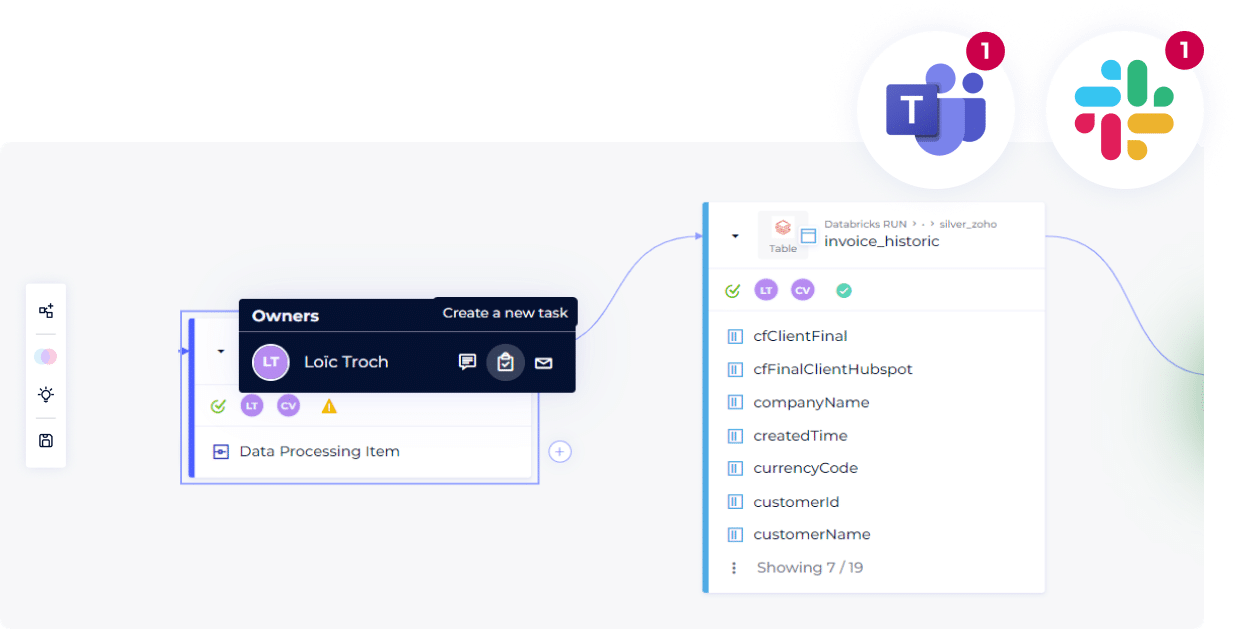
Plus, with integrations for popular platforms like Slack and Microsoft Teams, your teams can access and utilize the data they need without having to learn new tools.
They possess deep domain knowledge, decision-making authority, and an understanding of regulatory and compliance requirements.
In contrast, data stewards usually have a more technical or operational background and are tasked with maintaining data quality, integrity, and consistency daily.
Their skillset includes data management, metadata analysis, and familiarity with data governance tools and standards. While data owners define how data should be used, stewards ensure it is used correctly, making collaboration between the two essential for effective data governance.
In the "Data owner vs. data steward" debate, it's crucial to understand that one role doesn't overshadow the other.
They're two sides of the same coin, each bringing their unique strengths.
In the complex tapestry of data governance, their collaboration ensures that data remains a valuable and trusted asset for any organization.
Fueling smarter decisions for
200+ industry powerhouses.