According to Gartner, 50% of Chief Data and Analytics Officers (CDAOs) say they've already deployed data products. But the real question is: What exactly is a data product, and how do you build one that delivers tangible value?
In this blog, we’ll explore how to define, design, and deliver data products that go beyond the hype - Ones that have the potential to actually move the needle for your business.
What is a data product?
Not every dataset, dashboard, or report is a data product. A true data product is more than just a collection of data. It’s an integrated, curated, and self-contained combination of the following core elements:
Data
The raw material
Metadata
The context that gives data meaning
Semantics
A shared vocabulary and understanding
Templates
Standardized structures for reuse and scalability
These elements come together to form a consumption-ready product designed for specific business use cases.
Good data products are findable, trusted, domain-driven, and actively maintained. They’re approved for use, monitored for quality, and governed across their lifecycle with attention to security, ethics, and privacy.
Why data products, and why now?
The rise of data products reflects a growing need to make data useful, accessible, and scalable across organizations. In many enterprises, business users still spend most of their time requesting, finding, integrating, and preparing data. This can result in delayed insights, frustrated teams, and missed opportunities.
A well-designed data product enables a smooth handoff between the IT and business value chains, empowering teams to make faster, smarter decisions with confidence.
Avoiding data product overload
Many organizations fall into the trap of “data product washing,” or using the term without fundamentally changing how they manage or deliver data. This results in more noise and less value.
To avoid this, ask yourself: Is the data product solving a repeatable business challenge? Is it scalable? Is it delivering measurable value?
If the answer is no, you’re probably not dealing with an actual data product.
Types of data products
Data products aren’t one-size-fits-all. Here are three key types that serve different roles in the business:
- Utility products: Designed for wide use and immediate access. Think master data or finance reports. Success is measured by availability, awareness, and speed of access.
- Enabler products: Help drive decisions and outcomes. Examples include recommendation engines or predictive models. ROI, cost savings, and business impact measure success.
- Driver products: Core to business success. These are the products that differentiate your business or open new revenue streams.
Data Knowledge Studio
Restore context and understanding in complex data landscapes
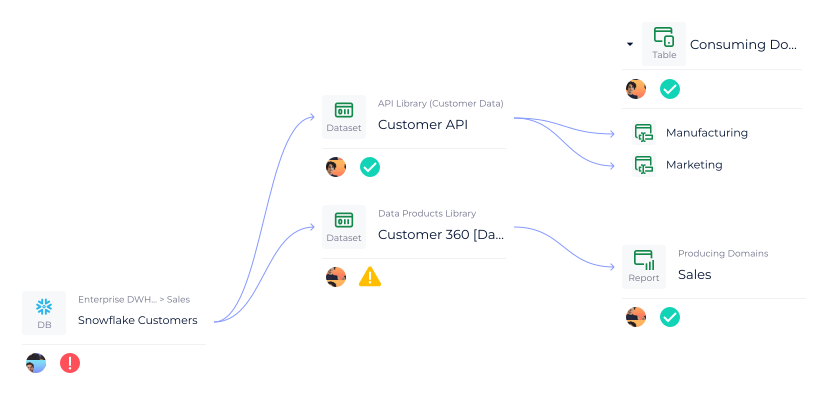
DataGalaxy’s Data Knowledge Studio’s graphical elements, workflows, and diagram tools help expert users create easy-to-understand models based on information stored in the Data Knowledge Catalog.
Together, these tools simplify data visualization and knowledge sharing so business users can grasp all the information they need at a glance.
Characteristics of good data products
Great data products share a few essential traits:
- Consumption-ready: Easy to find, access, and understand
- Up-to-date: Actively maintained and trusted
- Scalable: Designed for broad use, not just one-offs
- Approved: Governed, monitored, and certified for use
- Valuable: Delivering measurable outcomes for both business and IT
Importantly, not every business need requires a full-fledged data product. Use discretion before “productizing” everything, as they are often costly to build and maintain. Data leaders should focus on high-impact, repeatable use cases.
Building a data product: A step-by-step approach
Creating a successful data product requires more than just data engineering: It’s a true product management discipline. Here’s a practical framework for building data products:
- Develop a clear product vision: Start with a focused problem statement or hypothesis. What business need will this data product solve? Who are the users? What outcomes will it drive?
- Provision like a pro: Operational agility is key. Implement version control, configuration management, and integration hooks. Build with lifecycle in mind - Remember, every data product has a shelf life.
- Set contracts & governance: Establish clear terms of use, access controls, and billing models. Data governance isn’t a burden, it’s what builds trust and compliance.
Delivering & scaling data products
Delivery is a process, not a one-and-done task.
To get it right, it’s important to:
- Develop your product vision and hypothesis
- Own the product roadmap and iterate based on feedback
- Enable cross-functional handoff to data engineers, analysts, and business users
- Deploy with confidence, knowing your product meets quality, security, and usability standards.
Platforms like Snowflake and other modern data platforms can help operationalize this process, making it easier to manage data assets as products.
Tips for getting started
Ready to begin your data product journey? Here are some practical recommendations:
- Start small: Don’t boil the ocean. Begin with one or two business-critical use cases
- Plan for scale: Choose use cases that can evolve into reusable assets
- Identify bottlenecks: Create products that eliminate friction and unlock speed
- Define KPIs upfront: Success isn’t just usage, it’s value delivered
- Empower a data product manager: This role is crucial. They translate business needs into technical requirements and ensure alignment.
- Most importantly, communicate your wins: Early success stories build momentum and buy-in across the organization.
Final thoughts
Remember, value doesn’t come from the amount of data you have.
It comes from your agility to package, provision, and deliver it in a way that drives action. True data products unlock collaboration, increase trust, and open new opportunities for innovation and growth. After all, data isn’t the product - Value is!
Your data,
revolutionized
Transform the way you discover, manage, and govern your data. With DataGalaxy’s intuitive data catalog, achieve unparalleled efficiency, seamless collaboration, and full control over your data-faster than ever.
Request a demo
Fueling smarter decisions for
200+ industry powerhouses.