Data governance is the process of managing the availability, usability, integrity, and security of the data in enterprise systems.
Data governance covers all the rules and processes that ensure the organizational data’s structure, protection, and management.
Data is more effective with proper data governance. Data management is indispensable for analytics, enabling your company to make better, more informed decisions.
Additionally, good data governance ensures that the data you and your teams use is correct, consistent, and accessible to the right people in the company.
The benefits of data governance
Data governance enables organizations to:
Gather data from across the enterprise to get a global view
Identify data sources and processes
Verify data quality
Ease data integration
Ensure compliance with data protection laws and regulations
Allow the business teams to analyze and present the data
Educate the company on the need to use data correctly
Without effective data governance, companies run the risk of data consistency issues, which in turn results in unreliable enterprise and business intelligence reporting.
Do you need a data governance strategy?
If you are concerned about any of the following issues, then implementing a data governance strategy can help your business:
- Analyze your data in greater detail
- Make data-driven decisions to keep up with competition
- Keep up with security regulations requires strict control of your data
- Remove duplicates, incorrect, and obsolete data
- Recognize and mitigate security problems
- Manage several databases
Implementing organizational data governance in 3 easy steps
#1: Inventory and map the company’s data
The first step to establishing data governance is knowing where the company’s data is stored and identifying it.
Next, you can look at its lifecycle within the enterprise: What is the use of the data? How is it transformed? By whom?
CDO Masterclass
Upgrade your data leadership in just 3 days
Join DataGalaxy’s CDO Masterclass to gain actionable strategies, learn from global leaders like Airbus and LVMH, and earn an industry-recognized certification. This immersive program equips data professionals to drive impactful, data-powered transformations.

A data catalog is essential to get an overview of all data. Since it brings together all the company’s data, you can map it more efficiently and establish a common overview.
#2: Create a more data-driven organization
The implementation of a data governance plan varies depending on a project’s criticality and the company’s size.
In all cases, it is essential to determine the roles and responsibilities of each person in relation to the data.
Start by appointing Data Owners: Those who manage the data in their respective business area. It may also be helpful to appoint one or more Data Governance Managers to orchestrate all actions.
#3: Promote and encourage a data culture
Once you have all the tools necessary to manage data, it is important to encourage other business teams to utilize data in their decision-making.
It can often be challenging to promote an overarching data culture and a data-driven approach among your teams. To achieve this, it is useful to:
- Schedule various training sessions for all users
- Facilitate the exchange of information and the dissemination of best practices through a recurring meeting, an idea box on your intranet, or a data newsletter
How to manage organizational change
When building your governance strategy, it's important to involve all teams as early as possible: To identify data-related issues, ask the various business units.
You can then involve them and convince them to participate in the data governance project.
Establish clear rules
When implementing your data governance strategy, you are likely to encounter some resistance along the way, as data governance can restrict how data is handled within the organization.
A vital step to ensuring your governance project's success is establishing clear and comprehensive guidelines. These rules can be outlined by a data governance committee established within your organization.
Provide training
All teams in the company must have the tools to use data effectively. When it comes to data, consistency is vital. Consider carrying out a workshop or training session so that everyone can be on the same page about your data governance objectives.
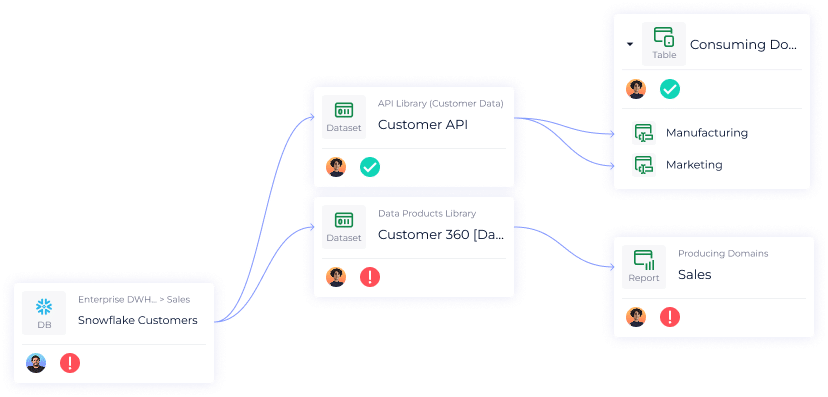
First-class Data Lineage
Explore, personalize, and visualize your end-to-end data journey with our first-in-class Data Lineage UX
DataGalaxy enhances data governance by establishing a trusted source of truth with our detailed exploratory Data Lineage visualization. Understand data flows, relationships, and health to ensure data integrity and enhance decision-making across your organization to ensure you never lose control.
Communicate clearly & often
Consistent communication throughout all stages of the project is key. Ensure that all project roles and ownership are clearly defined.
Choose the right data catalog
Choosing the right data catalog is perhaps one of the most important factors for your project. Data catalogs are a golden tool for your governance project, as they gather all of your organization's data in one place, making it accessible to everyone.
Conclusion
Good data governance will protect your company from serious data issues, by ensuring all data in your enterprise is tracked, cataloged, and protected.
Without such a plan, it will be more difficult for your business to manage the volume and quality of information that is currently being generated.
In the end, your governance project is more than just ensuring data is reliable: it’s about ensuring that your company has access to all the information it needs to make informed decisions effectively.
Your data,
revolutionized
Transform the way you discover, manage, and govern your data. With DataGalaxy’s intuitive data catalog, achieve unparalleled efficiency, seamless collaboration, and full control over your data-faster than ever.
Request a demo
Fueling smarter decisions for
200+ industry powerhouses.